Italy: Viterbo News 24 - Energy, ETS and Unfair Competition: Ceramics District in Civita Castellana Demands Concrete Answers

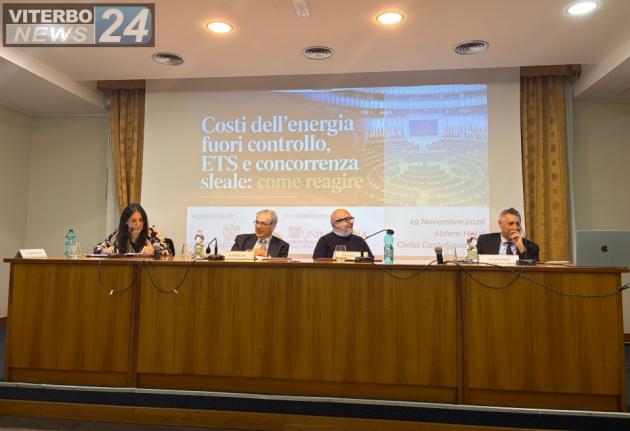
CIVITA CASTELLANA – Escalating energy costs, increasingly stringent European regulations requiring comprehensive review, and what is described as “unfair” international competition are the three critical issues that threaten to collapse Italian production. These topics were the focus of the conference “Out of Control Energy Costs, ETS and Unfair Competition: How to React,” organized by Confindustria Ceramica in collaboration with Unindustria. The event took place on November 19 at the Aldero Hotel in Civita Castellana.
The gathering, which was strongly advocated for and widely supported, brought together representatives from local, regional, national, and European institutions, alongside leaders from industrial associations and entrepreneurs from the ceramic district and other sectors. The central theme of the debate was the urgent need to identify concrete means and tools to defend the competitiveness of local businesses. This is a particularly delicate phase for a sector that serves as one of the main economic engines of the Tuscia region and is recognized as an international excellence.
Journalist Alessandra Sorge moderated the event. Speakers included Danilo Corazza, mayor of Civita Castellana; Augusto Ciarrocchi, president of Confindustria Ceramica; Andrea Belli, president of Unindustria Viterbo; Mauro Rotelli, chair of the Chamber of Deputies’ Committee on Environment, Territory and Public Works; European Parliament member Stefano Cavedagna; Maurizio Tarquini, director general of Confindustria; and Armando Cafiero, director general of Confindustria Ceramica. Antonella Sberna, vice president of the European Parliament, delivered the closing remarks.
The ceramic district at the heart of Tuscia’s economy
Mayor Danilo Corazza opened the discussion, emphasizing the strategic importance of Civita Castellana’s industrial district and the need for closer collaboration among businesses, trade associations and public institutions.
The mayor emphasized that ceramic production is far more than an economic sector. It is a core component of the local identity in Civita Castellana and the broader Tuscia region. The industry provides employment, stability for thousands of families, and opportunities for younger generations.
Corazza noted that when discussing industry in Viterbo, the conversation inevitably centers on Civita Castellana. He highlighted the history of a manufacturing tradition that began with clay processing and has evolved into a center of technological and productive excellence.
The mayor also pointed to the challenges posed by rising energy costs and competition from non-European producers. He warned that the consequences of an industrial crisis would not be limited to factory floors. Instead, they would impact the entire social and economic fabric of the community.
The local administration has also set the establishment of a higher technical institute as a priority, aiming to support the ceramic district by training new professionals and retaining both skills and young talent within the region. Corazza further emphasized the need to formally recognize the physically demanding nature of ceramic work, a measure intended to protect the health and dignity of workers in the sector.
Andrea Belli, president of Unindustria Viterbo, also focused on the central role of industry, urging that the manufacturing sector be acknowledged in the province's development strategies. He noted that Civita Castellana serves as the main industrial district in the Viterbo area and stands as a model of innovation and resilience.
"Industry must become central to Viterbo," Belli stated, while also highlighting the need to address bureaucratic hurdles, energy costs, and international competition. According to the Unindustria president, a productive system already under significant pressure, as seen in recent times, cannot be further disadvantaged by administrative procedures and delays.
Energy costs and ETS: Industry concerns
Augusto Ciarrocchi, president of Confindustria Ceramica, identified energy shortages, European emission regulations, and unfair competition as the three primary barriers to the district's competitiveness. He described these factors as three swords of Damocles hanging over the industry.
The sanitary ware sector in Civita Castellana holds a distinct position within the European landscape, producing high-quality goods that represent an industrial asset worth preserving. However, persistent challenges and exponential cost increases are stifling investment. This makes it increasingly difficult for companies to plan their development and safeguard their growth trajectories.
The situation regarding gas is particularly alarming, as it is an essential resource for ceramic production. Ciarrocchi explained that several long-term supply contracts, which had allowed some firms to control costs in recent years, are nearing expiration. This creates a risk of new price hikes, which would directly impact company budgets.
Among the potential solutions outlined by the head of Confindustria Ceramica are the use of domestic gas to support energy-intensive industries and the expansion of biogas production, with a portion of output allocated to sectors most vulnerable to high energy costs.
A second major issue concerns the EU Emissions Trading System. Ciarrocchi acknowledged the importance of decarbonization targets but emphasized that companies require time and tools compatible with currently available technologies.
Initial progress has been made through the revision of benchmarks for the tile sector, while manufacturers of sanitary ware still face unresolved issues regarding new costs associated with ETS2, whose implementation has been postponed to January 2028. Consequently, there is a strong demand for further commitments to prevent the new system from generating unsustainable expenses for businesses in the district.
Chinese competition and the call for anti-dumping duties
The third core topic of the conference addressed competition from Asian manufacturers, particularly Chinese firms. These producers benefit from significantly lower production conditions and costs compared to European companies, rendering market comparison impossible and unsustainable.
Ciarrocchi noted that the introduction of anti-dumping duties has already proven effective in other ceramic sectors. These measures have helped contain imports and protect European production. However, the situation for the sanitary ware sector remains undefined.
The new procedure targeting Chinese imports is therefore a critical step. This is especially true given the overcapacity in the Asian market and the Chinese real estate crisis. These factors are pushing a massive volume of products toward international markets.
Armando Cafiero, the general director of Confindustria Ceramica, highlighted the substantial economic scale of the issue. Data presented during his address indicated that when natural gas prices hovered around 35 euros per megawatt-hour, the sector’s total energy expenditure stood at approximately 500 million euros. With current market rates exceeding 80 euros, that bill could now surpass one billion euros.
Cafiero also pointed out the competitive disadvantage facing Italian manufacturers compared to other nations. He noted that domestic companies are burdened with higher energy costs than many of their European and non-European rivals.
Among the proposed solutions are measures to support domestic gas production, actions to address the price gap between Italian and European markets, and initiatives to encourage new investment in renewable energy sources.
On the commercial front, the director general urged a faster European response to anti-dumping measures. He noted that the current tariffs on tiles from India, ranging between 6% and 7%, are insufficient to counter unfair competition. In other sectors, however, the introduction of stricter and more effective duties has significantly curbed imports.
Political representatives committed to continuing discussions in national and European forums. European Parliament member Stefano Cavedagna emphasized the need for a thorough review of the ETS, including its potential suspension during the energy emergency, and called for more robust anti-dumping instruments.
Cavedagna also proposed assessing new methods to protect and enhance Italian industrial manufacturing through labeling systems and origin designations for industrial goods. The recent European framework on geographical indications for artisanal and industrial products offers an opportunity to distinguish Italian production from goods manufactured in other countries.
Mauro Rotelli, chair of the Chamber of Deputies' Committee on Environment, Territory and Public Works, outlined several government measures designed to support businesses and the production supply chain.
These initiatives include the refinance of the Sabatini Law, tools associated with the Transizione 5.0 program, and measures to improve product quality and efficiency. The latter also incorporates minimum environmental criteria in public procurement, with specific focus on the sanitary ware sector.
Rotelli further emphasized the expansion of the Single Window procedures for the Special Economic Zone, a provision included in an amendment to the budget law, as a potential tool for administrative simplification and investment support.
Maurizio Tarquini: «We need an Europe capable of defending its industry»
Maurizio Tarquini, the general director of Confindustria, characterized the current situation as a perfect storm for the European industrial system. He noted that the sector is squeezed between high energy costs, geopolitical tensions, and competition from nations operating under different regulatory frameworks.
Tarquini highlighted that a significant portion of Europe's emission reductions over the past two decades has resulted from the closure of production facilities. He argued that this outcome should not be the goal of environmental policies and must instead be actively opposed.
"We cannot reduce emissions by shutting down industries," he stated, emphasizing the need to provide companies with the time and tools necessary to manage the energy transition.
He also stressed the importance of developing renewable energy sources, removing bureaucratic obstacles that delay the construction of power plants, and investing in energy technologies, including nuclear power.
On the international front, Tarquini defended the need for a free market, but one based on equal rules for all. He explained that competition cannot be considered fair when some producers benefit from public support and conditions that European companies cannot match.
This led to a call for a more cohesive Europe, capable of presenting a common position towards China, India, and the United States, to prevent internal divisions from further weakening the continent's manufacturing sector.
Antonella Sberna: "The benchmark is a first result, but we must continue"
European Parliament Vice-President Antonella Sberna closed the conference, reviewing the work done by European institutions to bring the difficulties of the ceramic sector to the attention of the Commission.
Sberna noted that consultations with businesses and trade associations began in March 2025, following the submission of initial intervention requests that received a prompt and effective response. This process led to the discussion and approval of amendments to introduce a specific benchmark for the ceramic sector.
While this outcome is significant, it does not resolve all existing challenges. The revision of parameters serves as a first step to acknowledge the efforts companies have already made regarding innovation and emission reduction, particularly given that alternative technologies for production processes are not yet available.
The vice president also highlighted the Italian government's role in European negotiations and the need to continue working to prevent further penalties, especially ahead of the ETS2 implementation. As Sberna pointed out, the rapid intervention by the Meloni government allowed the deadline to be extended from January next year to January 2028.
The official outlined the provisions within the bill rates decree and the measures designed to lower wholesale gas prices. On the administrative front, he highlighted the work conducted at the European level to streamline the compliance requirements imposed on businesses.
Sberna concluded by issuing a direct appeal to the industrial sector, urging companies to continue submitting technical documentation and formal observations to the European Commission. This input is essential to strengthen the political and institutional response.
The final message from the conference emphasized the need to solidify cooperation among businesses, trade associations, and institutional representatives. The Civita Castellana district, given its historical significance and specific weight in the national production of sanitary ware, requires adequate competitive conditions to sustain investment, innovation, and job creation. The challenge extends beyond the survival of individual firms, encompassing the future industrial and economic trajectory of the entire region.
Frequently asked questions
What were the three critical issues discussed at the Confindustria Ceramica conference in Civita Castellana?
The conference focused on escalating energy costs, stringent European regulations, and unfair international competition. These factors are described as threats to the competitiveness of Italian ceramic production in the region.
Why is the new procedure targeting Chinese imports considered critical for the Civita Castellana district?
The procedure is critical because overcapacity in the Asian market and the Chinese real estate crisis are pushing massive volumes of products to international markets. This creates unfair competition that threatens the survival of local firms and the region's economic trajectory.
How does the current regulatory environment affect the future of the ceramic industry in the Tuscia region?
The environment requires concrete tools to defend business competitiveness against high energy costs and strict regulations. The challenge extends beyond individual firms to the future industrial and economic trajectory of the entire region, which relies on this sector.